Around 1470, Piero della Francesca painted Federico da Montefeltro, Duke of Urbino, in strict profile. Only the left side of the face is shown. The duke had lost the sight of his right eye, and the painter did not hide that fact so much as choose an angle that suited the face. The picture has hung in the Uffizi for centuries, and the profile has become its subject: forehead, nose, lips and chin in one unbroken line.
The chin is the part of that line patients think about least and viewers notice most from the side. Chin filler, meaning nonsurgical chin augmentation with hyaluronic acid, is often described as a small, safe touch-up. My argument is that it is a real change to the profile, that the evidence for it is still young, and that its rare complications occur in an area we have long called safe.
What does nonsurgical chin augmentation actually change?
It adds projection and shape to the front of the lower face, and filler is only one of six approaches in the literature. A systematic review in Plastic and Reconstructive Surgery pooled 54 studies covering 4,897 patients who had primary chin augmentation between 1977 and 2020 (Oranges et al., 2023). The authors sorted the methods into implants, osteotomy (cutting and moving the chin bone), autologous grafts, fillers, local tissue rearrangement, and combined implant and osteotomy procedures (Oranges et al., 2023).
Their conclusion was that all techniques provided consistently satisfactory cosmetic outcomes (Oranges et al., 2023). The complication figures they report are for surgery: 15.7% for implants and 19.7% for osteotomy, with mental nerve injury in 2.4% and 16.4% respectively (Oranges et al., 2023). Those numbers explain why many patients look for a needle instead of a scalpel. They do not tell us how filler compares, because the figures are for the surgical groups.
How well does chin filler work in the first three months?
In one early study, most of the volume was still there at 30 days and about six tenths of it at 90 days, with wide variation between patients. A prospective study in Plastic and Reconstructive Surgery used three-dimensional photogrammetry to measure volume after chin augmentation with a high-elastic-modulus (firm, shape-holding) hyaluronic acid filler, Juvéderm Volux, injected on the bone beneath the muscle by a single surgeon (Voytik et al., 2026).
Fourteen adults aged 22 to 55 were enrolled, with a mean age of 42.8 ± 10.6 years and a mean injected volume of 2.86 ± 0.36 mL (Voytik et al., 2026). The authors' Volume Maintenance measure was 79.8 ± 10.2% at 30 days and 62.1 ± 25.7% at 90 days (Voytik et al., 2026). Patient-reported scores on the FACE-Q questionnaire for chin shape, lower face, underchin and overall appearance improved significantly from baseline (p < 0.05) (Voytik et al., 2026).
The standard deviation at 90 days is large next to the average. That means the mean hides a range of experiences. The authors themselves call this an early-phase study, and it has 14 patients, one surgeon, one product and 90 days of follow-up (Voytik et al., 2026).
Does chin filler need midface or jawline filler alongside it?
A post-market study reports good short-term results for chin filler alone and for chin filler combined with lower face and midface treatment. The ARTIST study in the Journal of Cosmetic Dermatology was a prospective, multicenter, 8-week study of adults assigned to three groups: a high-firmness hyaluronic acid for the chin alone, the chin plus the marionette line areas beside it, or the chin, marionette lines and the midface, nasolabial fold or jawline (Nikolis et al., 2026).
The primary endpoint was the Global Aesthetic Improvement Scale responder rate, defined as "improved," "much improved," or "very much improved." It was 100% in all three groups at Week 8 by investigator assessment, and subjects rated themselves the same way at Weeks 4 and 8 (Nikolis et al., 2026). Satisfaction was high, and no unexpected adverse events were reported (Nikolis et al., 2026).
A 100% figure invites a question about what was measured. The lowest qualifying grade on that scale is simply "improved," the study ran only eight weeks, and its three groups were treatment algorithms rather than a comparison against no treatment or another product (Nikolis et al., 2026). It shows that these combinations were well tolerated over two months. It does not show that one plan beats another.
Is the chin a safe place to inject filler?
The chin has a reputation as a safe site, and a case series in the Journal of Cosmetic Dermatology shows that the reputation has an exception. The authors describe unilateral tongue necrosis after vascular occlusion from hyaluronic acid injected in the chin, and note that their literature search found only one earlier case report (Thanasarnaksorn et al., 2023).
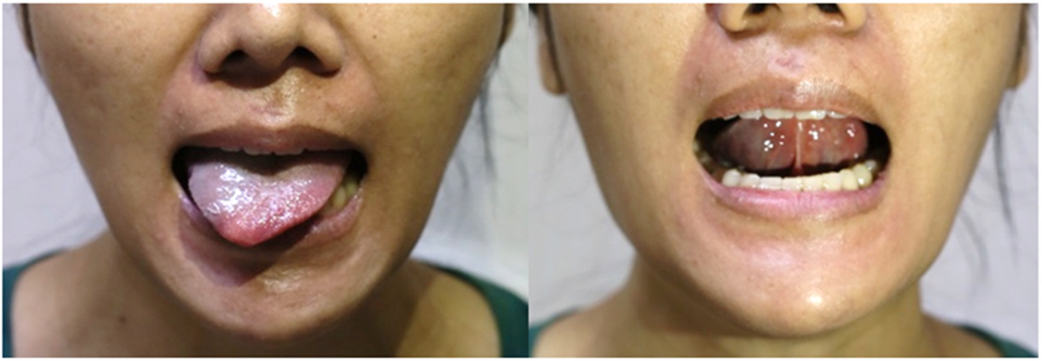
All of their patients recovered completely after high-dose hyaluronidase injected in multiple planes (Thanasarnaksorn et al., 2023). The authors suggest that variation in vascular anastomosis (the way small arteries connect with each other) may have played a part, and that bone variation could also have contributed (Thanasarnaksorn et al., 2023).
A case series cannot tell us how often this happens. Its value is different: it shows where a problem can arise in a region that clinicians rarely think of as dangerous, and what the treatment looked like when it worked.
The strongest objection
Some will say that with surgical complication rates near 16% to 20%, a filler is plainly the lower-risk route to a stronger chin (Oranges et al., 2023). That is partly true. Filler avoids implants and bone cuts, and the 8-week post-market study reports no unexpected adverse events (Nikolis et al., 2026).
But a fair comparison needs the same outcomes measured over the same time in comparable patients. Two of the filler studies here follow patients for 90 days or less, one has 14 participants (Voytik et al., 2026), and the safety report is a case series with no denominator (Thanasarnaksorn et al., 2023). The surgical figures come from decades of published work (Oranges et al., 2023). Lower risk is plausible. It is not yet demonstrated by matched data.
What should a chin filler consultation cover?
A good consultation looks at the face from the side and asks what the chin needs to do for the whole profile. The studies here gave patients a defined plan: a single high-firmness product on the bone beneath the muscle (Voytik et al., 2026), or a stepwise plan that added other lower face and midface areas (Nikolis et al., 2026). It is reasonable to ask which of those approaches is being proposed and why.
Safety deserves its own part of the conversation. Because a tongue necrosis series exists for this very site (Thanasarnaksorn et al., 2023), it is reasonable to ask whether hyaluronidase is available in the room and whether the injector has a plan for a blocked vessel. It is also fair to ask what volume to expect at three months, since the average in one study was about 62% of the initial measure with a wide range (Voytik et al., 2026).
The Clinical Bottom Line
Chin filler is a reasonable option for people who want more projection without surgery. The recent studies point in the same direction: patients were satisfied (Nikolis et al., 2026; Voytik et al., 2026), volume was largely retained in the first month (Voytik et al., 2026), and no unexpected adverse events appeared over eight weeks (Nikolis et al., 2026).
The caution is about certainty. The data are early and small, the safety evidence for this site comes from case reports, and the comparison with surgery has not been made head to head. What we still lack are longer follow-up, larger samples, and studies that put filler and surgical options side by side.
The painter of the Duke of Urbino knew that a face is judged in profile. A chin filler should be judged the same way: by what it does from the side, and by what it costs if something goes wrong.
For clinical assessments and consultation in Seoul: itsdrbock.com
References
Nikolis, A., Rivers, J. K., Rosen, N., Weinberg, F., Prygova, I., & Bromée, T. (2026). The ARTIST post-market study: Evaluating a high G' hyaluronic acid (HA) injectable for chin combined with midface HA filler treatments. Journal of Cosmetic Dermatology, 25(4), Article e70807. https://doi.org/10.1111/jocd.70807
Oranges, C. M., Grufman, V., di Summa, P. G., Fritsche, E., & Kalbermatten, D. F. (2023). Chin augmentation techniques: A systematic review. Plastic and Reconstructive Surgery, 151(5), 758e–771e. https://doi.org/10.1097/PRS.0000000000010079
Thanasarnaksorn, W., Thanyavuthi, A., Prasertvit, P., Rattanakuntee, S., Jitaree, B., & Suwanchinda, A. (2023). Case series of tongue necrosis from vascular complications after chin augmentation with hyaluronic acid: Potential pathophysiology and management. Journal of Cosmetic Dermatology, 22(3), 784–791. https://doi.org/10.1111/jocd.15475
Voytik, M., Khan, S., Broach, R. B., & Percec, I. (2026). Three-dimensional volumetric analysis of chin augmentation using hyaluronic acid filler: A prospective study. Plastic and Reconstructive Surgery. Advance online publication. https://doi.org/10.1097/PRS.0000000000013346