In 1859, Dante Gabriel Rossetti painted a woman with a full, heavy mouth and titled the picture Bocca Baciata, borrowing a line from Boccaccio's Decameron: the mouth that has been kissed loses none of its freshness, but renews itself like the moon. The picture is remembered largely for that mouth.
Lips do not renew themselves like the moon, and neither does a syringe of hyaluronic acid. Patients who ask me about lip filler tend to ask about shape: fuller, more defined, less flat. That is a fair place to start. It is not the place where the evidence is most useful.
My argument is that lip augmentation works for most patients, and its most common side effects are expected rather than dangerous. The questions that deserve a patient's attention are two much rarer ones: an artery that does not sit where the diagram says it should, and a reaction that can arrive years after the injection.
Does lip filler work? What the randomized trials show
Yes, moderately to highly, according to the best available evidence. A 2026 systematic review and meta-analysis of randomized controlled trials screened 2,038 articles and included 16 studies of hyaluronic acid lip filler (Wen et al., 2026). Across those trials, 60% of participants achieved improvement in lip fullness, 82% showed improvement in aesthetic appearance, and 68% reported satisfaction (Wen et al., 2026). The authors summarized efficacy and patient satisfaction as "moderate to high" in the studies with the highest level of evidence (Wen et al., 2026).
These are pooled averages, not a promise for any individual lip. They do answer the first question a patient reasonably asks, which is whether the treatment does what it says.
Is swelling after lip filler a complication?
Swelling is the expected result, not the exception. The same meta-analysis found that 50% of participants had some adverse effect, but only 1.1% had a serious adverse event, defined as one requiring treatment, follow-up, or lasting beyond 30 days (Wen et al., 2026). Among the effects reported, swelling was the most common (78%), followed by firmness (48%), bruising (34%), and tenderness (33%) (Wen et al., 2026). The authors' conclusion was that severe reactions were rare but adverse events were common (Wen et al., 2026).
A retrospective series in the Journal of Cosmetic Dermatology followed 253 women treated at five centers in Brazil between 2020 and 2024 with a single hyaluronic acid product and a technique the authors call the Multi Vector Lip technique (Menezes et al., 2025). Mean volume was 1.06 ± 0.21 mL per patient, and satisfaction on a four-point scale averaged 3.92 for patients and 3.89 for physicians (Menezes et al., 2025). Edema occurred in 15.8% and bruising in 11.1%, with no vascular occlusion over 9 to 12 months of follow-up (Menezes et al., 2025).
The lower rates than in the trials are probably a matter of design. Trials record events by protocol, while a retrospective series is limited to what was documented, and this one had no comparison group (Menezes et al., 2025). The trials are the better guide to how common side effects are. The series shows what one technique looked like in a large, varied group of patients.
Why the upper lip artery is the real safety question
The superior labial artery does not follow a single standard course. In a cadaver study of 60 hemifaces from Korean and Thai specimens, the artery fell into four patterns: the most common in 56.7%, then 21.7% and 15.0%, and in 6.7% the artery was absent (Lee et al., 2015). Its origin lay 12.1 ± 3.1 mm lateral to the corner of the mouth, and it ran along the vermilion border at a depth of roughly 3 mm (Lee et al., 2015). The authors advised caution because of this variability (Lee et al., 2015).
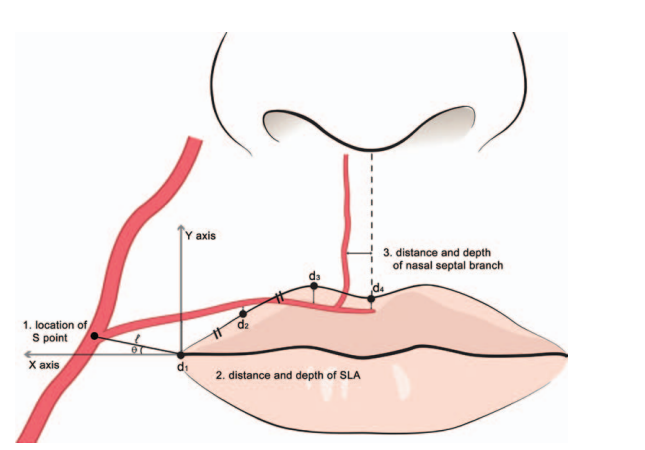

A 2025 pictorial review in the Journal of Cosmetic Dermatology drew together ultrasound studies of the lip. It reported mean depths of 5.3 to 5.6 mm for the superior labial artery and 4.2 to 5.2 mm for the inferior labial artery, most often in the submucosal plane (58.5%), then the intramuscular plane (36.2%), and rarely the subcutaneous plane (5.3%) (Wu et al., 2025). Depth estimates differ from study to study and by method, which is itself the point: no two lips can be assumed identical. The review recommends very superficial injection, just below the dermis, and describes ultrasound as a way to map vessels and to find filler from earlier treatments (Wu et al., 2025).
The technique paper points the same way. It places most product in the subcutaneous plane and advises aspirating for about three seconds each time the needle is inserted (Menezes et al., 2025).
Can lip filler cause problems years later?
Rarely, yes, and the delay can be long. A systematic review of 19 studies (4 case series and 15 case reports) covered 30 patients with reactions to lip filler (Coppini et al., 2024). Granulomatous foreign body reactions, a lumpy inflammatory response to the material, accounted for 23 of them (76.6%), and the mean time to onset was 57.9 ± 54 months, with a median of 24 months (Coppini et al., 2024). Hyaluronic acid was involved in 14 of the 30 cases (46.7%), alongside silicone and several other materials (Coppini et al., 2024). No included study had reported the reaction to a regulatory authority (Coppini et al., 2024).
Case reports cannot tell us how often this happens. The authors also note that reactions to hyaluronic acid may be underestimated because they can be reversed with hyaluronidase (Coppini et al., 2024).
The strongest objection
Some will say that a 1.1% serious adverse event rate in trials, plus a 253-patient series with no vascular occlusion, means lip filler is a solved problem. That is partly true. Most treatments go well, and the randomized evidence supports it (Wen et al., 2026).
But each source has limits. The technique series was retrospective, noncomparative, limited to women, and two of its authors report speaking for a filler manufacturer (Menezes et al., 2025). Trials that follow patients for months are poorly placed to catch a reaction that appears at a median of 24 months (Coppini et al., 2024). And the late reactions surface only in case reports, which have no denominator. Reassurance and uncertainty are both real here.
What to ask at a lip filler consultation
A good consultation about lip augmentation spends as much time on anatomy as on shape. It is reasonable to ask how the injector accounts for variation in the superior labial artery (Lee et al., 2015), which plane and depth will be used and why (Menezes et al., 2025; Wu et al., 2025), and whether ultrasound is available to look at the lip, particularly if you have had filler before (Wu et al., 2025).
The conversation should also reach beyond the day of the injection. Because a reaction can appear after a median of 24 months (Coppini et al., 2024), it is reasonable to ask which product will be used and how the clinic follows patients afterward. A late lump or swelling is easier to work through when the product and the date are known.
The Clinical Bottom Line
Lip filler is a reasonable, evidence-supported option for people who want more fullness or definition. In randomized trials, most participants improved, and serious adverse events were uncommon (Wen et al., 2026). Swelling, firmness, and bruising should be expected rather than feared.
The decisions worth the time are about vessels and follow-up. The upper lip artery varies from person to person (Lee et al., 2015), and reactions can arrive long after the syringe is gone (Coppini et al., 2024). What we still lack are prospective comparisons of injection techniques and good estimates of how often late reactions occur.
Boccaccio's mouth renews itself like the moon. A filled lip does not, which is why the follow-up matters as much as the injection.
For clinical assessments and consultation in Seoul: itsdrbock.com
References
Coppini, M., Caponio, V. C. A., Mauceri, R., Pizzo, G., Mauceri, N., Lo Muzio, L., & Campisi, G. (2024). Aesthetic lip filler augmentation is not free of adverse reactions: Lack of evidence-based practice from a systematic review. Frontiers in Oral Health, 5, Article 1495012. https://doi.org/10.3389/froh.2024.1495012
Lee, S. H., Gil, Y. C., Choi, Y. J., Tansatit, T., Kim, H. J., & Hu, K. S. (2015). Topographic anatomy of the superior labial artery for dermal filler injection. Plastic and Reconstructive Surgery, 135(2), 445–450. https://doi.org/10.1097/PRS.0000000000000858
Menezes, M. V. A., Dezanetti, C. B. G., Penna, F. W. P., Cury, R. S. L., & de Aquino, S. B. G. (2025). Aesthetic treatment of the lips with hyaluronic acid filler: The multi vector lip technique. Journal of Cosmetic Dermatology, 24(9), Article e70445. https://doi.org/10.1111/jocd.70445
Wen, Y. E., Perez Rivera, L. R., Wyatt, H. P., Lee, W. Y., Oh, C., Boyd, C. J., & Karp, N. S. (2026). Efficacy and safety of hyaluronic acid lip fillers: A systematic review and meta-analysis of randomized controlled trials. Aesthetic Surgery Journal, 46(5), NP24–NP32. https://doi.org/10.1093/asj/sjaf224
Wu, W.-T., Chang, K.-V., Naňka, O., Chang, H.-C., Ricci, V., Mezian, K., & Özçakar, L. (2025). Lip sonoanatomy and relevance to aesthetic filler injections: A pictorial review. Journal of Cosmetic Dermatology, 24(4), Article e70164. https://doi.org/10.1111/jocd.70164