A patient sits down and asks, almost in passing, to "just fix the bump" on her nasal bridge with filler, the way she might ask for a touch-up under her eyes. I say yes, but more slowly and more carefully than she expects, and she wants to know why.
A nasal filler is not a low-stakes injection with a high-stakes reputation. It has the least room for error of any site we inject in the face, and the anatomy explains exactly why.
In Nikolai Gogol's short story The Nose, a minor official wakes one morning to find his nose gone, only to spot it later riding through St. Petersburg dressed as a state councillor, outranking the man it left behind. The satire lands because losing your identity to your own nose is absurd, and also because it is not quite absurd at all. Long before rhinoplasty existed as a specialty, a damaged or amputated nose carried enough social weight that techniques for rebuilding one are among the oldest in the history of surgery. What has changed since Gogol's century is not how much the nose matters. It is how people now try to change it, and how well they understand what a needle risks that a scalpel does not.
Why the nose leaves so little room
Most places we inject filler have a cushion, a layer of fat between the skin and the named arteries that, if compressed or pierced, can starve skin or, in the rarest and most frightening cases, the retina. The nose does not have that cushion. Its skin sits close to cartilage and bone, with very little of the soft tissue that gives a cheek or a temple its margin for error (Lu et al., 2022).
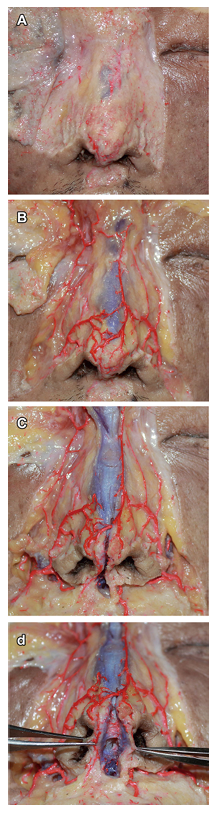
The two arteries that matter most in this space, the dorsal nasal artery and the lateral nasal artery, do not run the same course in every patient. In a cadaver study of the region, the dorsal nasal artery was present in only 58% of specimens and crossed the midline in 16% of them, while the lateral nasal artery was more constant but still crossed to the opposite side of the nose in 18% of cases (Lu et al., 2022). No two noses are wired quite the same way, which is exactly the problem: a technique that is safe on one patient's vessels can sit directly against a vessel in the next. The same study found the supratip area, just above the tip, to be relatively safer than the tip itself, because fewer of these variable branches cross through it (Lu et al., 2022).
What the safety data actually show
The fullest picture comes from a systematic review and meta-analysis that pooled 37 published reports on nonsurgical rhinoplasty with filler, spanning 23 cohort studies and 14 case reports and a combined 8,604 patients (DeVictor et al., 2021). Across the cohort studies, the overall rate of any adverse outcome was 2.52%, most of it bruising (1.58%) and hematoma (0.13%) (DeVictor et al., 2021).
The numbers worth pausing on are the rare ones. Vessel occlusion, meaning filler actually blocked a blood vessel rather than simply sitting near one, was reported in 30 episodes, or 0.35% of the pooled group (DeVictor et al., 2021). Skin necrosis appeared in 7 reports (0.08%), and vision loss, the complication every injector fears most, in 8 (0.09%) (DeVictor et al., 2021). Infection accounted for another 6 reports, or 0.07% (DeVictor et al., 2021).
These are small percentages. They are also not zero, and they cluster in the one structure on the face with the least room to absorb a mistake. A less-than-one-percent risk of blindness is still a risk of blindness, and it belongs in the conversation before the injection, not after it.
The largest single series to date
Not every recent study is about catastrophe. A 2024 retrospective analysis in the Journal of Cosmetic Dermatology followed 492 patients treated with a hyaluronic acid filler developed specifically for structural correction of the nose, making it one of the largest single-product safety series published for this use (Jalali, 2024). It reinforces the same pattern the pooled data show: for most patients, most of the time, a carefully placed nasal filler is safe and reaches its goal (Jalali, 2024). The point of this piece is not that nasal filler is unusually dangerous. It is that its safety depends entirely on technique, product choice, and injector judgment in a way that a cheek or lip filler simply does not.
The strongest objection
Some will say that a 2.52% overall complication rate, with serious events under one percent, means this is a solved problem, no different from any other filler. That is partly true. Most nasal filler treatments go well, and the pooled data support that (DeVictor et al., 2021).
But "most of the time" means something different in a place where the failure mode is skin necrosis or blindness rather than a bruise you can conceal. A cheek filler placed in the wrong plane usually leaves a lump you can dissolve away. A nasal filler placed in the wrong plane can become an emergency within minutes. The anatomy explains why: the same tight, fat-poor space that lets a small volume of filler reshape a nose is the space that leaves an unpredictable artery with nowhere to move out of the way (Lu et al., 2022).
The Bottom Line
The case for caution here is not that nasal filler is unusually dangerous. It is that the anatomy leaves almost no room to be careless. A good injector plans around the fact that vascular anatomy varies from nose to nose rather than working from one standard diagram, chooses a product and a technique, needle or cannula, deliberately rather than by habit, and keeps hyaluronidase on hand with a clear plan to use it immediately if the skin blanches or the pain is out of proportion to the injection (Lu et al., 2022). And the goal has to stay honest: filler can soften a bump or correct a mild asymmetry, but a change large enough to belong in an operating room belongs there, not in a syringe.
Gogol's official got his nose back in the end, restored as suddenly and inexplicably as it disappeared. Real noses do not get that luxury, which is exactly why this is the one filler where caution is not a matter of taste. It is the anatomy talking.
For clinical assessments and consultation in Seoul: itsdrbock.com
References
DeVictor, S., Ong, A. A., & Sherris, D. A. (2021). Complications secondary to nonsurgical rhinoplasty: A systematic review and meta-analysis. Otolaryngology–Head and Neck Surgery, 165(5), 611–616. https://doi.org/10.1177/0194599820987827
Jalali, A. (2024). Nonsurgical rhinoplasty using the hyaluronic acid filler VYC-25L: Safety and patient satisfaction in a retrospective analysis of 492 patients. Journal of Cosmetic Dermatology, 23(2), 426–433. https://doi.org/10.1111/jocd.15997
Lu, Y., Hong, W.-J., Luo, C.-E., Zhan, W.-F., & Luo, S.-K. (2022). Vasculature of the nasal cartilage region related to filler injection. Aesthetic Plastic Surgery, 46(5), 2461–2468. https://doi.org/10.1007/s00266-022-02942-3